CUDA and RERA Approved Plots in Chikkaballapur: What You Should Actually Check Before Buying
A few years ago, "CUDA approved" was just fine print on a brochure. Now it's one of the first things buyers type into Google before they even call a broker. That shift didn't happen by accident — it happened because too many people bought plots around Bengaluru that looked perfect on a site visit and turned into a headache the moment they tried to get a loan, transfer the khata, or resell.
So if you're looking at land in Chikkaballapur or near Nandi Hills and you keep seeing "CUDA approved" and "RERA registered" on every listing, this article is for you. We'll go through what these approvals actually mean, why they're not the same thing, and what you should be asking for before you put down a booking amount.
First, What Is CUDA?
CUDA stands for Chikkaballapur Urban Development Authority — it's the government body that oversees how land gets developed in and around Chikkaballapur. Before a developer can legally sell plots in a layout, that layout's site plan, roads, land-use category, and infrastructure design have to go through CUDA's review process.
In plain terms: a CUDA-approved layout has been checked by the authority responsible for planning that region. It's not a guarantee that everything about the project is perfect, but it does mean the basic groundwork — roads, drainage, open spaces, land classification — has been reviewed rather than just promised by the developer.
Why This Actually Matters When You're the One Paying
It's easy to get swept up by a good price and a nice-looking layout map. But here's what approval status quietly affects down the line:
Getting a loan. Most banks won't sanction a plot loan on an unapproved layout, full stop. If you're planning to finance the purchase, this alone can decide whether the deal is even possible.
Getting your khata transferred. Individual khata — the document that proves the plot is legally recorded in your name for tax and ownership purposes — is far smoother in an approved layout. In unapproved ones, this can drag on for years, or not happen at all.
What you're actually walking into. Roads that are 40 feet wide on paper but 15 feet wide in reality, drainage that backs up every monsoon, no proper electricity line — these are the kinds of problems that only show up after people have already moved in. Approved layouts are far less likely to have these surprises because the plan was checked before construction began.
Selling it later. When you eventually sell, the first question serious buyers and their lawyers ask is about approvals. A clean answer here makes your property easier — and often faster — to sell.
CUDA Approval and RERA Registration Are Two Different Things
This trips up almost everyone, so let's be direct about it: CUDA approval and RERA registration are not interchangeable, and having one doesn't mean you have the other.
CUDA approval is about the physical layout — is the land use correct, are the roads and drainage planned properly, does the site plan match what's actually being built.
RERA registration is about the developer's conduct — are they disclosing project details honestly, are timelines and promised amenities documented, is there a legal channel for you to complain if something goes wrong.
A project can technically have one without the other. That's exactly why you should ask to see both documents separately, not just take "we're approved" at face value.
Why Chikkaballapur Keeps Coming Up in These Searches
It's not hype — there are real reasons Chikkaballapur has become a serious contender for people looking around North Bengaluru:
It sits close enough to North Bengaluru to make the commute realistic, especially with the airport corridor nearby. It's also right next to Nandi Hills, which means the surroundings are genuinely green and quiet rather than another concrete extension of the city. And because it's still developing, entry prices tend to be more accessible than the already-built-up pockets closer to the city.
None of that replaces due diligence — but it explains why so many buyers are looking here in the first place.
Mistakes People Keep Making With Plot Purchases
A few patterns show up again and again with buyers who ran into trouble later:
They bought the cheapest plot in the layout without asking why it was cheaper. They took the developer's word on approvals instead of asking to see the actual documents. They skipped an independent lawyer's opinion on the title because "the broker said it's clean." They didn't check if water and electricity connections actually existed on-site, versus being "planned." And a lot of people simply assumed CUDA and RERA meant the same thing, and stopped asking questions once they heard either word.
Every one of these is avoidable with about a day's worth of checking before you commit money.
What to Actually Ask For Before You Book a Plot
Before you pay anything, get clarity on:
- The CUDA approval reference and layout plan
- The RERA registration number for the project
- Clear title and ownership documents, checked independently by your own lawyer
- Whether roads, water, and electricity are actually built, not just shown on a master plan
- The khata transfer process and expected timeline
- Any development planned in the surrounding area that could affect value
If a developer is reluctant to share any of this, that reluctance is your answer.
Why Smaller, Boutique Layouts Are Gaining Favor
Big townships get the marketing budgets, but a growing number of buyers are choosing smaller, low-density layouts instead. The appeal is fairly simple — fewer plots means fewer neighbors, less shared maintenance, and a quieter place to actually live rather than a densely packed subdivision. For buyers who want the regulatory comfort of an approved layout without the scale of a mega-project, boutique developments are becoming the middle ground.
A Project Worth Looking At: Fortune One Vistaa
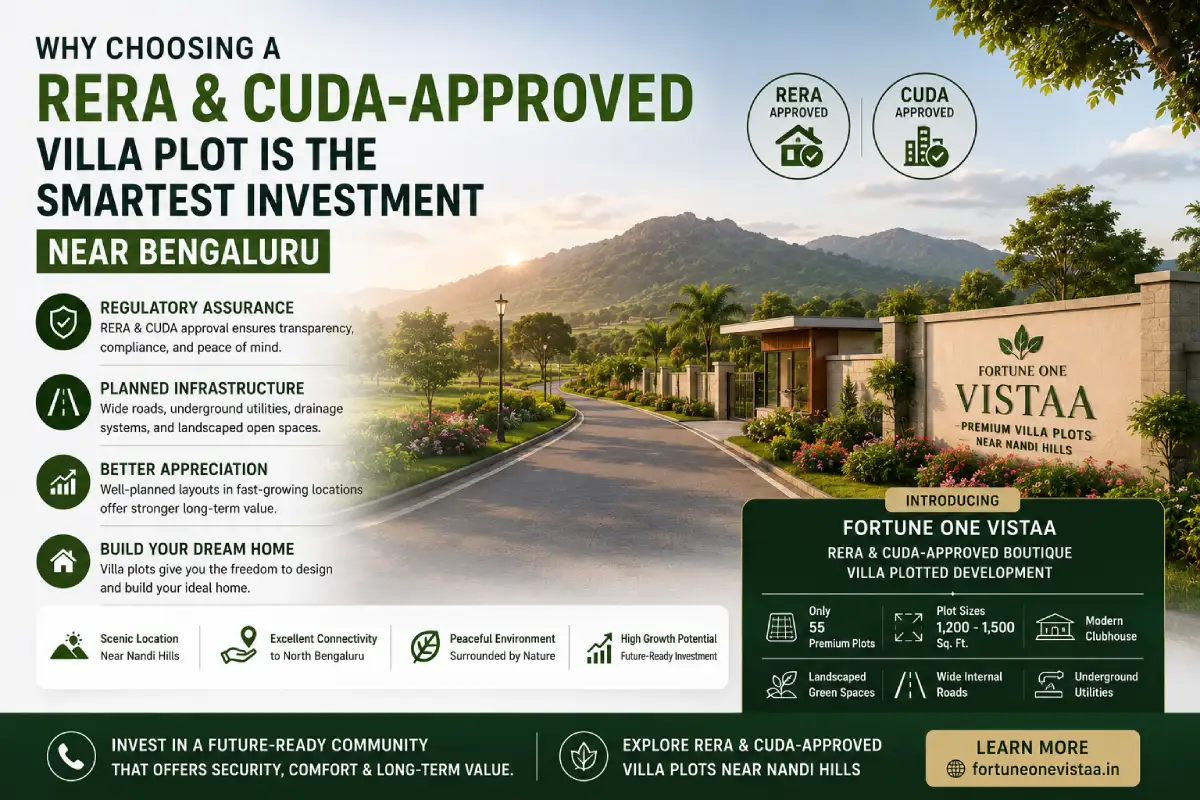
If you're specifically looking for a CUDA and RERA approved villa plot near Nandi Hills, Fortune One Vistaa is one project that fits that description directly — it carries both CUDA approval and RERA registration, so buyers aren't left choosing between planning compliance and legal transparency.
It's located near the Isha Foundation in Chikkaballapur and deliberately kept small, with just 55 villa plots ranging from 1,200 to 1,500 sq. ft. The layout includes landscaped green spaces, wide internal roads, underground utilities, and a clubhouse, along with straightforward connectivity to North Bengaluru.
Whether the plan is to build a home eventually or hold the plot as an investment, it's the kind of project where you can actually verify the approvals rather than take them on faith.
You can look into the details at fortuneonevistaa.in.
Note: if you can share the specific CUDA approval reference number and RERA registration number for this project, we can add them directly here — listing the exact numbers (rather than just saying "approved") is one of the strongest trust signals for both buyers and search engines.
A Few Questions People Usually Ask
Do I really need to check both CUDA and RERA, or is one enough?
Check both. They cover different things, and a project passing one review says nothing about whether it passed the other.
Does CUDA approval mean there's no legal dispute on the land?
No — it only covers planning and infrastructure compliance. Title and ownership still need a separate, independent legal check.
Can I still get a home loan on an unapproved layout?
It's difficult. Most banks specifically require layout approval before they'll sanction a plot loan, so this can rule out financing entirely.
What's the one document I should never skip asking for?
The original approval and registration certificates — not a summary, not a verbal assurance, the actual documents with reference numbers you can verify.
The Bottom Line
The plot that looks the best on a Saturday site visit isn't necessarily the safest one to buy. Approval status, title clarity, and real (not promised) infrastructure matter more over a ten-year horizon than the view from the entrance gate. Ask for the paperwork, get it checked independently, and let Chikkaballapur's growth work for you instead of against you.